
 St. Patrick was a Romano-British citizen, kidnapped in Britain at age 16 and served as a slave for 6 years in Wood of Fochoill, Ireland. He later returned to the homeland of his captivity, Ireland, to spread the gospel and plant churches. His mission to Ireland 457-492 began at age 40 after being turned down after his first request to be commissioned as a missionary.
Although I’m sure Patrick enjoyed a good beer, his life counted for much more than good times and green clovers.
Although I’m sure Patrick enjoyed a good beer, his life was counted for much more than good times and green clovers. Patrick was a man of remarkable faith and mission. In the 5th century, Patrick planted more than 200 churches and won 100,000 people to Christ. How did this happen? Far from contemporary attractional church models, Patrick pioneered mission to the pagan tribes of Ireland through innovative strategy, incarnational ministry, and robust faith in Christ.
St. Patrick, the Missional Leader
When entering a new town or province, the first thing Patrick would do was befriend the local ruler. Very often that leader would come to Christ and permit Patrick to evangelize the area. Next, Patrick would establish monasteries for the training of Christians, but unlike many of his contemporaries, Patrick emphasized mission as a part of Christian training. In essence, he established missionary training centers in every city in order to effectively reach the whole of Ireland.
In essence, Patrick established missionary training centers in every city in order to effectively reach the whole of Ireland.
Patrick also learned the local language, the old Gaelic, and translated the gospel into their culture. He developed their “flavor of writing” and adapted colloquialisms and was known for his persistent study of Gaelic culture. He painted heaven as a great feast, not an angelic reunion, which appealed to the banquet culture of the Irish.
St. Patrick, the Missiologist
Patrick was a savvy missionary and developed numerous ways to communicate the gospel which reflected thoughtful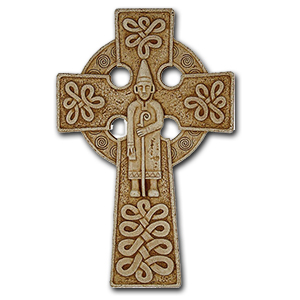 engagement of culture. When confronting pagan Druid religion, which used the circle to represent reincarnation, Patrick superimposed the cross onto the circle of reincarnation to demonstrate the triumph of the cross over druid belief. Hence the Celtic cross. Notice that the circle never overlays the cross, but the cross is on top of the circle.
Patrick new that the gospel must interact with the world; it must reject, redeem, and recreate life and culture under the lordship of Christ.
To be sure, this was no artistic whim; it was a direct power encounter with the pagan belief of his day. Patrick new that the gospel must interact with the world; it must reject, redeem, and recreate life and culture under the lordship of Christ. Maybe we need to come up with a cross over the top of a $100 bill! It was also Patrick that used the indigenous shamrock (three-leaf clover) to explain the Trinity to the Celts. Three leaves, one clover; three persons, one God.
St. Patrick, Man of God
In addition to his missional savvy, Patrick’s Confessio reveals a man who was immersed in Scripture. He was shaped by his relationship with the Trinity and passionately devoted to the Celts. Consider his exemplary prayer for any Christian or church planter:
and without complaint I would faithfully be of service to that pagan people to whom the love of Christ translated me and granted me, as long as I live, if I should be worthy; that at last with humility and in truth I might serve them. And so, according to the measure of faith of the Trinity it is my duty without the fear of censure to make known the Gift of God and his eternal consolation without fear faithfully to expound everywhere the name of God (Confessio, I. 65-75)