Creation Project

Posts Tagged ‘ Mark Driscoll ’

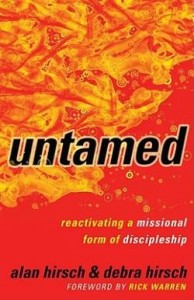
Review: Untamed by Alan Hirsch (pt 1)

If Alan Hirsch wasn’t a household name among the mission-minded before the VERGE conference, he certainly is now. Alan was kind enough to lend his 6 Elements of missional DNA as the architecture of the VERGE missional community conference. Add to that the outstanding introductory videos that explain each of the 6 Elements, and you’ve got a quite Hirschian splash. As if that wasn’t enough, Alan & his wife Deb drop a new book called Untamed: Reactivating a Missional Form of Discipleship.

Structure of Book

Those familiar with The Forgotten Ways will immediately recognize that Untamed is an expansion of one of the 6 Elements of mDNA—missional discipleship. However, the book does not assume this familiarity.

The Introduction is extremely helpful in laying out a map for reading the book. There are four main sections (Theology, Culture, Psychology, Mission), each containing four Signature Themes (Jesus-shaped discipleship, Shema Spirituality, No Mission, No Discipleship, & Of Idols and Prophets).

Recovering the Incarnational Jesus

Chapter One is a cultural exorcism of distorted American Christology, a calling out of moralistic and hypermasculine (read=Mark Driscoll critique) views of Jesus. Could Hirsch be more Jesus-centered than Driscoll?! He levels an irenic but incisive critique. Speaking of men more effeminate than Driscoll’s “caricature of Jesus,” he writes: “they are unacceptable to Jesus as they are…but this strikes a blow against the gospel itself.” Before we start defending and accusing missional leaders, let’s be sure to make this about about Jesus, not personalities, something both Driscoll and Hirsch would want.

Hirsch keeps centering on Jesus. Warning us of cultural stereotypes of Jesus, he says that Jesus must be freed to relate to all people. Hirsch doesn’t simply exorcize the demons, he replaces them with an incarnational Jesus, a Jesus who enters our humanity and empathizes with our condition as the basis and example of mission. On this incarnational note, a couple quotes are worthy of reflection:

  • “It is true that Jesus is like God, but the greater truth…is that God is like Jesus!” (36)

  • “Jesus holiness was compelling. Sinners flocked to him.” (46)

  • “For Jesus, acceptance must precede repentance.” (48)

I love the first two quotes but have some pause on the third. I’m sincerely grateful for this book, chapters one and nine in particular, which underscore and unpack an incarnational way of following Jesus. I’ve been provoked, challenged, and encouraged. Thanks, Alan & Deb!


Doctrine – by Driscoll

Mark Driscoll’s newest and largest book drops soon. It’s called Doctrine: what Christians Should Believe, a kind of systematic theology for the 21st century.

From the Introduction:

Doctrine seeks to trace the big theological themes of Scripture along the storyline of the Bible. This book is packed with truth without many stories for illustration and entertainment.

Table of Contents

Introduction

Chapter 1 – Trinity: God Is

Chapter 2 – Revelation: God Speaks

Chapter 3 – Creation: God Makes

Chapter 4 – Image: God Loves

Chapter 5 – Fall: God Judges

Chapter 6 – Covenant: God Pursues

Chapter 7 – Incarnation: God Comes

Chapter 8 – Cross: God Dies

Chapter 9 – Resurrection: God Saves

Chapter 10 – Church: God Sends

Chapter 11 – Worship: God Transforms

Chapter 12 – Stewardship: God Gives

Chapter 13 – Kingdom: God Reigns

Endorsements:

“I like Doctrine very much. It is a relatively short, clear, and accurate topical summary of biblical teachings, focused on the practical application of doctrine. There is much here to aid readers who have thought in the past that theology was too complicated, uninteresting, or irrelevant. This book is none of those things. It takes off on wings of eagles. It is so important today that believers understand and become committed to all that God’s Word says. This book is a wonderful tool to help them do that.”
John M. Frame, Professor of Systematic Theology and Philosophy, Reformed Theological Seminary

“Mark Driscoll and Gerry Breshears have written a remarkably insightful treatment of central biblical teachings, with a few surprising but welcome choices. Doctrine is meaty, well-researched, clearly written, interesting, and refreshing—a rare combination. Those who know that truth matters will relish this book. If you don’t know that truth matters you should read it anyway, and enjoy watching your mind and heart change.”
Randy Alcorn, Author of HeavenSafely Home, and Deception


Great Interview on Acts 29

By Tim Challies HERE


Driscoll. Austin. Relationships.

Driscoll will be in town speaking at the Song of Solomon Conference at Hill Country Bible this Friday and Saturday. This is great, practical material that will give you a better bearing on relationships, romance, marriage, and singleness.

[youtube=http://www.youtube.com/watch?v=hteXaD4ZqbE&feature=player_embedded]

Register Here.


The Difference between Responsibilty and Concern

Great post by Mark Driscoll.

I envision that everyone has a backpack with responsibilities that God has given for him or her to carry. Some peoples backpacks are big, and others are small. Nonetheless, God has called us each to fill up our pack with specific responsibilities. Some people are lazy and try to take things out of their pack and get others to carry them instead. Examples include the able-bodied man who lives with his mom, making her responsible for his housing and food; the lazy employee who cannot keep a job and expects his or her friends and family to always give him or her money; and the irresponsible young woman who assumes the government, her family, or a wealthy boyfriend will pay the price for her foolish life choices. Tragically, for many, the whole definition of someone being loving, godly, and spiritual is that they are willing to carry the loads God has called others to carry. This is not ministry. This is co-dependency, co-idolatry, and sin.


Books That Don't End: Death By Love

You know the kind of book that is so good you don’t want it to end? I typically experience this with fiction, but this year there have been a few non-fiction books I have read slowly and not finished–because they are so good! Over the next few weeks, I’ll share from some of my reading in the books that I don’t want to end.

Death By Love – This is easily Mark Driscoll’s best book yet. Death By Love is a series of actual letters Mark wrote to people struggling with serious sin and suffering. Here are a few of the chapter titles:

  • Lust Is My God”
    Jesus Is Thomas’s Redemption

    “My Wife Slept with My Friend”
    Jesus Is Luke’s New Covenant Sacrifice

    “I Am a ‘Good’ Christian”
    Jesus Is David’s Gift Righteousness

    “I Molested a Child”
    Jesus Is John’s Justification

    “My Dad Used to Beat Me”
    Jesus Is Bill’s Propitiation

    “He Raped Me”
    Jesus Is Mary’s Expiation

Chapter after chapter is charged with honesty, empathy, and wisdom. Rich in practical counsel and biblical theology, this book should be required reading for all courses in Pastoral Ministry. Driscoll takes categories from systematic theology and applies them using biblical theology in a very practical way. Brilliant and grace giving. A basic outline for counseling I use was coined by David Powlision: 1) Listen to their Story 2) Empathize with their Story 3) Redemptively retell their Story. I’ll use this to frame Driscoll’s counsel for a victim of abuse:

  • Empathize with Story: “I think I understand what you are trying to say. For a man to devastate his family like your father did means that his simply saying ‘sorry’ is not enough to erase the list of sins he has accrued or the damage h has done. I hope to untangle some of the conflict you are living in…”
  • Listened to Story: “you spoke of building forts in the backyard and pretending you lived there instead of in the house with your father because you longed for the day you could move out and never return.”
  • Redemptively Retell Story: “Bill, you must realize that not only could God’s active wrath be poured out on your father, but it just as easily could have been poured out on you…not only is your father a sinner who needs his sins propitiated, but you too are a sinner who likewise needs his sins propitiated…not only did Jesus suffer like you; in a very real sense he suffered at the hands of both you and the father at the cross…therefore, therefore you need not merely let your father of the hook because he became a Christian. Further, you need not punish him…I know that you fear forgiving your father…However, because God is sovereign and good, through that evil you have been given one of the deepest appreciations and insights of the doctrine of propitiation of anyone I have ever met.”

Free preview here. More info at ReLIT.


Free Father's Day Book


Advance Conference Audio

Resurgence has put up the Advance Conference audio:


Pastoral Wisdom w/ Driscoll @ Gospel Coalition

Some of Mark Driscoll’s most recent talks have been packed with pastoral wisdom. Do not miss his talk A Call to Endure which deserves to be heard or watched by pastor and wife together. He calls us to endure: emotionally, physically, spiritually, parentally, spiritually. Some of his insightful points include:

  • The only person that can truly pastor you is your wife.
  • Your personality calcifies as you get older apart from the gospel you will become a calcified version of yourself.
  • The one idol your church will let you worship is ministry. Don’t lose intimacy with Jesus.

In his 1 Timothy address at GC, Driscoll lays out three types of people pastors are called to interact with: positives, negatives, neutrals. He reaches deep into his own experience to bring pastoral empathy and ministry wisdom.

Read his notes here.


A29 Reflections on Preaching and Endurance

The Seattle A29 bootcamp was one of the best I’ve been to. Here are a few highlights:

Preach the Word

With intoxicating passion Matt Chandler exhorted us, text after text, to be the unlikely people who proclaim the gospel and encounter opposition for being faithful to the Word of God. A standby message that can’t be preached enough in an age of theological fads, cultural fascination, church planting tricks, and the very scary American church industry.

He reminded us that when God wants to work, he repeated comes to a man. He met Moses on a mountain instead of dethroning Pharaoh by himself. He likes to use the unlikely to accomplish his redemptive purposes in history. What hope for us. But calls us to preach unpopular messages, like Isaiah’s sensory malfunction message in chapter 6, or Jeremiah’s message to “uproot and tear down,” without very little experience of “building up.” And it is this kind of embodying and preaching of the gospel of Christ crucified that, though unpopular, actually changes the whole world!

Progressional Dialog

Matt was a little hard on progressional dialog/dialogical preaching. The crux of his point was that the Bible repeatedly shows people “preaching” not “dialoging” the Word and therefore that should be our method too. I think people will probably mishear Matt on some of this. In explaining the progression of dialog Matt summed it up as going from “nothing to nothing.” To be fair, his explanation came from Preaching Reimagined by Pagitt which carries a whole host of theological baggage with it. But I wonder if we can separate the method out and celebrate the dialogical homiletic a bit more? I have friends who use diaological preaching that is robust, gospel-centered, and far from “nothing to nothing.” Matt, do you think there’s room for this method provided the content delivered is biblically faithful?

A Call to Endure

Mark Driscoll’s message on endurance was jam-packed with wisdom for people, pastors, and planters alike. Focusing on the practicals of running the Christian race well and to the end, Driscoll highlighted a number of areas in which we need to endure: spiritually, physically, maritally, parentally, pastorally. His call to “love Jesus not use him” should pierce the armor of self-made ministry significance. Every pastor battles this—significance by ministry—instead of significance by Jesus. He reminded us that: “ministry is the one idol the church will let you get away with.

Additionally, Driscoll’s comments on our wives being pastors to their husbands was rich. People used to scathing Mark for his complementarianism will do well to heed his words on this. Far from bull-headed masculinity and chauvinism, Mark pleaded with pastors and their wives to move together in ministry. How? By a pastor allowing his wife to minister to him emotionally, spiritually, relationally, etc. The calling of a pastor’s wife is not to some fanciful, exalted position of “first lady” but to the all-important place of strengthening her husband. Mark commented regarding this role of pastor’s wife: “everything else can be delegated in the chruch.