Creation Project

Posts Tagged ‘ tim chester ’

Gospel-Centred Family (Chester & Moll)

When I received Tim Chester & Ed Moll’s extremely helpful book Gospel-Centred Family, I was determined to write an immediate review. Weeks passed. I kept going back to the short 93 page booklet to remind myself of gospel principles in raising my children. After reading through chapter 5, Disciplining a Child’s Heart, again this morning with my wife, I decided it was time to do the review!

Summary: One of a Kind

Gospel-Centred Family is simple, accessible, applicable, and profound. Many of us were raised to think that the gospel was something we should accept, not something we always need. This is equally true of parents. Like our children, we need the gospel to start and continue the Christian life. Instead of stooping to bribery, manipulation, behavior management, or emotionalism in parenting, Gospel-Centred Family lifts us up with gospel principles that point to Jesus as our King (not just example), to the heart (not just behaviors), and to understand how grace (not family goals) will transform a child into the image and beauty of Christ.

Book Structure: Easy to Read

The book is broken up into Four Sections: 1) Gospel-Centred Family 2) Grace-Centered Family 3) Word-Centered Family 4) Mission-Centred Family. Each chapter in each section contains a Principle, Biblical Background, and Questions for Reflection. I’m typically not into this kind of layout. In a lot of books that take this approach make the interaction feel “forced.” Not so with Gospel-Centred Family. Quite the opposite! The questions and principles are helpful and I’m considering using the whole book as the basis for a course in our church.

Disciplining a Child’s Heart: Gospel-centered & Practical

Instead or reviewing each chapter, I will provide a sample review of the book by examining one chapter.

Principle: Addressing the heart matters ore than controlling behavior.

Biblical Background:  Colossians 2:20-3:10. This background shows how Scripture does not advocate a rule-based approach to change, but that identity as a new creature in Christ is what changes us from the inside-out.

From Controlling to Addressing the Heart: Using helpful anecdotes, the authors explore common misconceptions about why children misbehave (“influences” not the heart). Many of us fall prey to these misconceptions, disciplining our children in ways that reinforce behavior-centered, not heart-centered parenting. We often try to control a child’s behavior instead of instruct their hearts. Consider some adapted examples:

  • Manipulation – “Can’t you behave like your sister?”
  • Fear – “If you don’t obey, you’ll get hit by a car.”
  • Bribery – “I’ll give you some candy if you obey me.”
  • Emotionalism – “After all I’ve done for you…”
  • Inconsistency – “Okay, just this once.”

We all fall into these, some more than others. My wife and I had an honest conversation about where we see one another choosing these behavior control approaches. We encouraged one another to address the heart more often.

Good Discipline

The authors then turn the corner of critique to instruction:

“…if your aim is to teach your child the ways of God, then your discipline will be calm, clear, consistent, and concentrated on the motives of their heart. The goal is not control—that’s your agenda. God’s agenda is a child who delights to know and serve Him.

They unpack each of the 4 Cs for godly discipline:

  1. Calm: The focus of discipline is the child’s hear rather than your emotional state.
  2. Clear: Make your commands clear…explain why they are being disciplined.
  3. Consistent: Set consistent boundaries..by always following through with warnings…and being consistent between parents.
  4. Concentrated on the heart: Focus on motivation, not just behaviour, e.g. “What did you want?” “Why did you do it?”

Concluding Thoughts

These principles and practices are immensely helpful, but they must be applied together as parents. Make sure you have some discussion time together over these things. Unite in prayerful repentance over failure and joyful resolve to not just change your kids’ behavior but instruct their heart. Parents should never stop talking about how to raise their kids. Fathers should lead out. As children grow older, it is important to move from discipline to self-discipline. As they grow, create times of discussion between parents and children so that you can grow in the gospel together.

Bonus: Gospel-centered Family Rhythms & Resources


2 Books on Gospel Change

Westminster Bookstore is running a great deal on two great books. For One Week Only get both books for $14.50! (50% off retail price).

Offer expires on Thursday, April 1st.

Buy both for $14.50
« (50% Off) »


LEAD ’09: Gospel. Community. Mission.

In 2009 Tim Chester and I spoke at the LEAD ’09 conference which focused on Leading the Church in Gospel, Community, and Mission. The conference was packed with great content which has been captured on video and audio. Some of the sessions include:


You Can’t Prove Yourself (so stop trying)

Do you ever find yourself trying to prove yourself…to Others, to Self, or to God? Here are a few ways we slide away from the approval of the Gospel to proving ourselves. The categories of proving yourself to Others/Self/God are adapted from Tim Chester’s forthcoming U.S. publication of You Can Change, an excellent book for Gospel Change. The explanations are largely mine, as well as the Gospel aphorisms. So, don’t expect all of this in You Can Change, but do expect some great material that thinks about change along similar lines. As you read, consider which one of these categories fits you and let us know how you’re finding the Gospel more reliable than yourself.

Proving Yourself To Others

When we try to prove ourselves to others, we set ourselves on impressing them—a spouse, a boss, a parent, a peer. We want so desperately to be cheered by them, that we’ll overwork or compromise our health or morals. The approval of others becomes the most important standard in our lives, so we sacrifice our beliefs, our convictions, our standards so that we will be accepted by others. When others are our standard, we will always fail to find the approval and acceptance we long for. Performance Fail. The Gospel reminds us that others cannot offer us lasting acceptance. That God not others are our standard. We will never sufficiently prove ourselves to others because we are flawed. God is our standard. We fail to meet it, but the gospel reminds us that Jesus has met God’s standard for us! Others aren’t nearly as forgiving as Jesus is. We need not prove ourselves because Jesus has proven our worth. We don’t’ have to seek approval from others because are approved by grace in Christ. That is Good News.

Proving Yourself To Self

When we try to prove ourselves to ourself, we set ourselves on improving upon our past.  We try to perfect ourselves. “I used to look at porn but now I don’t.” “I used to not go to church, but now I do.” “I used to not be missional, but now I am.” This may work for a while, as long as we succeed, but as soon as we fail ourselves the bottom of our worth drops out. Our sense of worth and acceptance comes from moral or spiritual self-improvement, not from Jesus. Our standard is Self not God. Peformance Fail. Self isn’t nearly as forgiving as Jesus. The Gospel reminds us that we have not sinned against ourselves, but we have sinned against God. But the Gospel reminds us that we must look to God for the ultimate standard. God provides a righteous, not relative standard, and it can be met alone by faith in Christ, by resting in his acceptance. From our place of acceptance and rest in Jesus, we can live a life that reflects God’s holy standard, instead of striving against ourselves. We don’t have to perfect ourselves because imperfect people cling to a perfect Christ. This too is Good News.

Proving Yourself To God

When we try to prove ourselves to God, we set ourselves on impressing God. We try to perform for his acceptance and approval. “Look how devoted I’ve been to you.” “I’m involved in so much mission and church ministry, surely God is happy” We content ourselves with proving ourselves to God. We try to be good enough, missional enough, spiritual enough. We may even secretly believe that even though we’ve been forgiven in Christ, God’s favor is based on our performance after salvation. We think to ourselves: “If I practice enough spiritual disciplines, then I will gain the spiritual intimacy I long for.” We think that we can put God in our debt. Our standard is God, which is good, but the problem is that we can’t reach his standard. Performance Fail. The Gospel reminds us that we are still sinners, never good enough apart from Christ AND it calls us to stop trying to prove ourselves to Him. The Gospel calls us to rest in God’s approval of us in Christ. To receive his forgiveness for sinful performance and rely on Christ’s performance for us. We need not impress God, because Jesus has impressed God for us. This is Good News!

Gospel Approval (it’s so much better!)

Here are a few gospel aphorisms that might be helpful to memorize when you are tempted to prove yourself to others, yourself, or God.

  • We don’t’ have to seek approval from [Others] because are approved by grace in Christ.
  • We don’t have to perfect [Ourselves] because imperfect people cling to a perfect Christ.
  • We don’t have to impress [God] because Jesus impressed him for us.


Sovereignty of God & Prayer

This Monday we discussed the Sovereignty of God & Prayer at City Seminary. We defined the sovereignty of God as: “The pleasure of the triune God in ruling over all things.” We then applied this doctrine to anxiety in our lives, which is often manifested in: controlling fear, constant busyness, or distracting habits.

Detecting Anxiety Idolatry

How do you discern where anxiety is festering in your life? Try to find where your feelings are out of control, and you’ll find your idol (paraphrase of TK). For instance, controlling fear may paralyze you in parenting, air travel, or solitude. Our feelings can mislead us. As Thom Yorke says, “Just because you feel it doesn’t mean its there.” Just because you fear failure doesn’t mean its there or to be trusted. Anxiety offers us a false promise: “Be anxious and you’ll have control or peace.”

Moving Beyond Anxiety into Sovereignty

In order to move beyond anxiety, we need a true promise to rely on. Phillipians 4:6-7 promises us “peace that surpasses comprehension” if we will bring our anxieties to God in prayer. Now, this promise can only be true and trustworthy if God is sovereign. If he isn’t, he can’t promise incomprehensible peace in all circumstances. However, there’s a condition on this promise. We must give up self-sovereignty before we can trust in God’s sovereignty. Where are your emotions out of control? What is sovereign in your life? God or fear or busyness?

Prayer Works with a Sovereign God

The way forward from paralyzing anxiety is to trust in God’s sovereignty. This doesn’t happen through mental resignation; it requires genuine prayer and trust in God. Repentance from trusting in false promises and new faith in true promises. This gift of prayer brings us into sweet communion with God.

But if God is sovereign, doesn’t he already know what I will ask? Yes, he does (Matt 6:8) but that doesn’t mean we shouldn’t pray. He’s ordained our prayers to sovereignly accomplish our good and keep his promises of peace. Tim Chester puts it well:

God offers us prayer as a possibility and commands us to pray because he is a relational God who purposes to have a relationship with his people. It is not that God receives new data through our prayers, but that through our prayers information is clothed in love making it communication. God has ordained that he will be affected by our loving communication to him.

In prayer, anxious humans meet a joyfully sovereign God. He calls us to deep dependence on him and promises to replace our anxiety with peace.

Books on Prayer

Articles


Audio Up from LEAD 09

LEAD 09 with Tim Chester and me went really well. Two days of stimulating talks, practical breakouts, and great conversations. Some of the audio is out with video to come. I thought the following audio that is currently available was


LEAD 09 LIVE!

Here at LEAD 09 where Tim Chester just finished his first session on a biblical theology of missional community. Q&A now on practical, communal decision-making. Good stuff! You can view this conference for free, live at livestream.


You Can Change – the 4 Gs

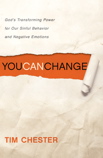
Austin City Life City Groups went through Tim Chester’s book You Can Change YCC will be released in the U.S. in March 2010 (new cover to the left) this summer. It was a powerful experience for all our communities. In chapter 5, Tim helps us fight the fight of faith for Gospel change by introducing four powerful truths we can believe in face of the lies of sin.

1. God is great so we dont have to be in control

2. God is glorious so we dont have to fear others

3. God is good so we dont have to look elsewhere

4. God is gracious so we dont have to prove ourselves

Our friends at Soma Church are now calling these the “4 Gs”, which is catchy. I encourage you to meditate on the power of God’s grace promised to us in the 4 Gs. When we are tempted to fear, flee, flaunt, or force our way, God promises a better way. He is Great, Glorious, Good, and Gracious. Memorize these phrases. Look for their truth in the Scriptures. Meditate on God’s goodness, glory, greatness, and graciousness….and Enjoy Grace!

You Can Change Resources


Total Church Resources

If you haven’t read Total Church, buy it today. If you’d like some more resources on Total Church, check out the following:

My Series of Posts on Total Church. – excerpts and reflections on the book from when we were in Core Team stage. Also check out Three-Strand Evangelism

Total Church study guide. – This is a good tool to use when Building Missional Core Teams for church planting, and for helping re-orient existing churches around the gospel, community, and mission.

Resurgence Resources – includes helpful teaching videos by Steve Timmis and other blog posts.


Brief Review of Chester's You Can Change

The book You Can Change, by Tim Chester, promotes a gospel-centered approach to sanctification by asking ten major questions. The real fruit of the book comes through the required Personal Change Project, an endeavor reminiscent of the Personal Counseling Project required by David Powlison’s Dynamics of Biblical Change (and quotes CCEF authors throughout).

The Trinity and Change

Chester gives a little more attention to the role of the Trinity in producing personal change than most books on this topic. The Trinity gives us a new identity: 1) children of the Father 2) bride of the Son and 3) the home of the Spirit. He emphasizes the role of the Spirit in giving us the desire to do what is right, believe what is true, and cherish what is good. The simple emphasis on surrender to our inclination to do what is right and believe what is true was a refreshing reminder that the Spirit is already at work in us and that, very often, we simply need to yield to him. The Spirit opposes sinful desires and promotes God-honoring desires. The challenge is to “sow to the Spirit” by “saying yes to whatever strengthens our Spirit-inspired desires.” When we fail to yield to the Spirit, Scripture calls us to repentance and faith. The way we begin and continue in the Christian life is the samerepentance and faith in Christ.

Who is God?

Ten questions guide the reader through categories similar to Dynamics (heat, thorns, root, fruit, etc). In order to get to the root, Chester says that we must find the lie behind every sin and then identify one of four truths we are refusing to believe: 1) God is not great 2) God is not glorious 3) God is not good 4) God is not gracious. While a little simplistic, this typology is helpful and moves towards Christ being the expression of Gods greatness, glory, goodness, and grace.

Pride and Preciousness of Christ

The chapter on what stops change was personally transforming. Chester claims that pride isnt just a sin; its part of the definition of sin. In sin we lift ourselves up over God, but in the gospel grace flows down to us. We need to give up on ourselves, to repent of self-reliance in sanctification and receive Gods grace for change. As one prone to self-reliance and pride, this was a word of grace. Jesus not only shows me humility but humbles me through the cross. The god of self-reliance (or self) is not merciful. When I let it down, it does not forgive. Instead, self-reliance beats me when I am down saying: You could have done better. You need to work harder. You can do it. But the gospel tells me the truth: You cant do it, but God in Christ through the Spirit can do all things through you. When I let Christ down, he does not beat me; he dies for me. When I rely on him, not on myself, I discover that he not only dies for me but also lives for me, changing me into his very own image. This is a humbling, transforming, gospel-driven way to live and I am grateful for it!